
AN IMMOVABLE FEAST
EATING MEAT IN PICARDY

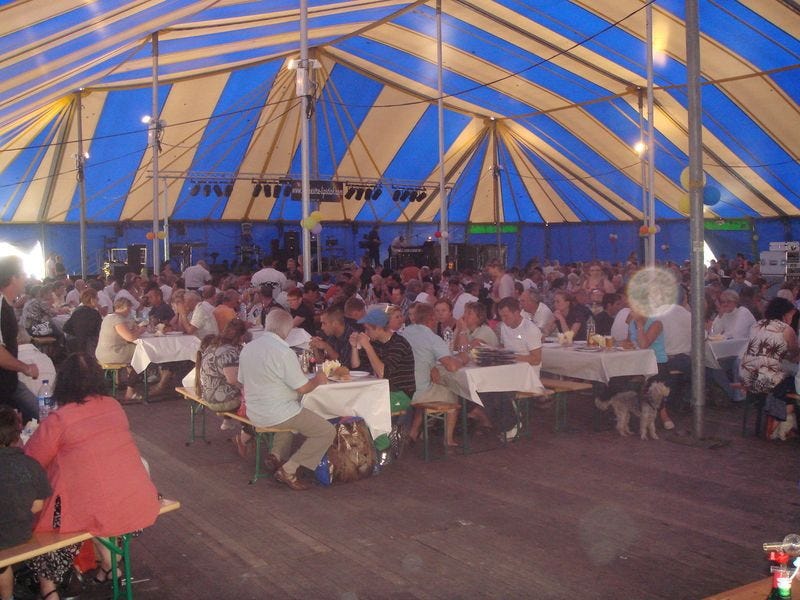
Eating an ox at Bugnicourt.
Communal feasts, sometimes called canons, are a French tradition. An entire village lays on a celebration of the local speciality. In the seaside town where we spend our summers, it’s fresh sardines. Elsewhere, it’s aligote – mashed potatoes with cheese – or aioli; garlic mayonnaise with cod fish and vegetables. Lately, these banquets are back in the news with a company called Le Canon Français. It caters for as many as 3500 people, who wolf down platters of charcuterie and periodically burst into noisy chorus, often with political or racist overtones. A few years ago, Marie Dominique and I attended a similar but smaller and not notably political event in Picardy for a book called The Perfect Meal: In Search of the Lost Tastes of France. The following is an edited version.
A little after 11 one Saturday night, the phone rang.
“Boris,” a voice said curtly. “You’re still looking for that roasted ox?”
“You know I am.”
“Well, I’ve found one. Take down this name. Bugnicourt.”
I did. ”What is it?”
“A village. Near Douai.”
That was in Nord-Pas de Calais, the furthest north-eastern point of France before you entered Belgium.
“And what’s up there?”
“An ox roast.”
At last! I’d begun to believe that I’d never find one. It was just what I needed to end the book.
“When is it?”
“Ah. That’s the difficulty.”
“Why?”
“Because it’s now.”
We got away almost exactly at midnight. Two hours later, we left the autoroute. Marie-Dominique rolled down a window The cool night air smelled of grass and earth. No cities here. This was la France profonde. Then there were lights, and a barrier, and people.A man in a down jacket and flat cap, cigarette smoking at the corner of his mouth, manned the barricade. I powered down the window and asked “La Fete du bœuf?”
”Le Bœuf en broche?” The bull on a spit? That sounded about right.
“Exact.”
“Past the church,” he said. “At the football field, on the other side of the hill. You can’t miss it.”
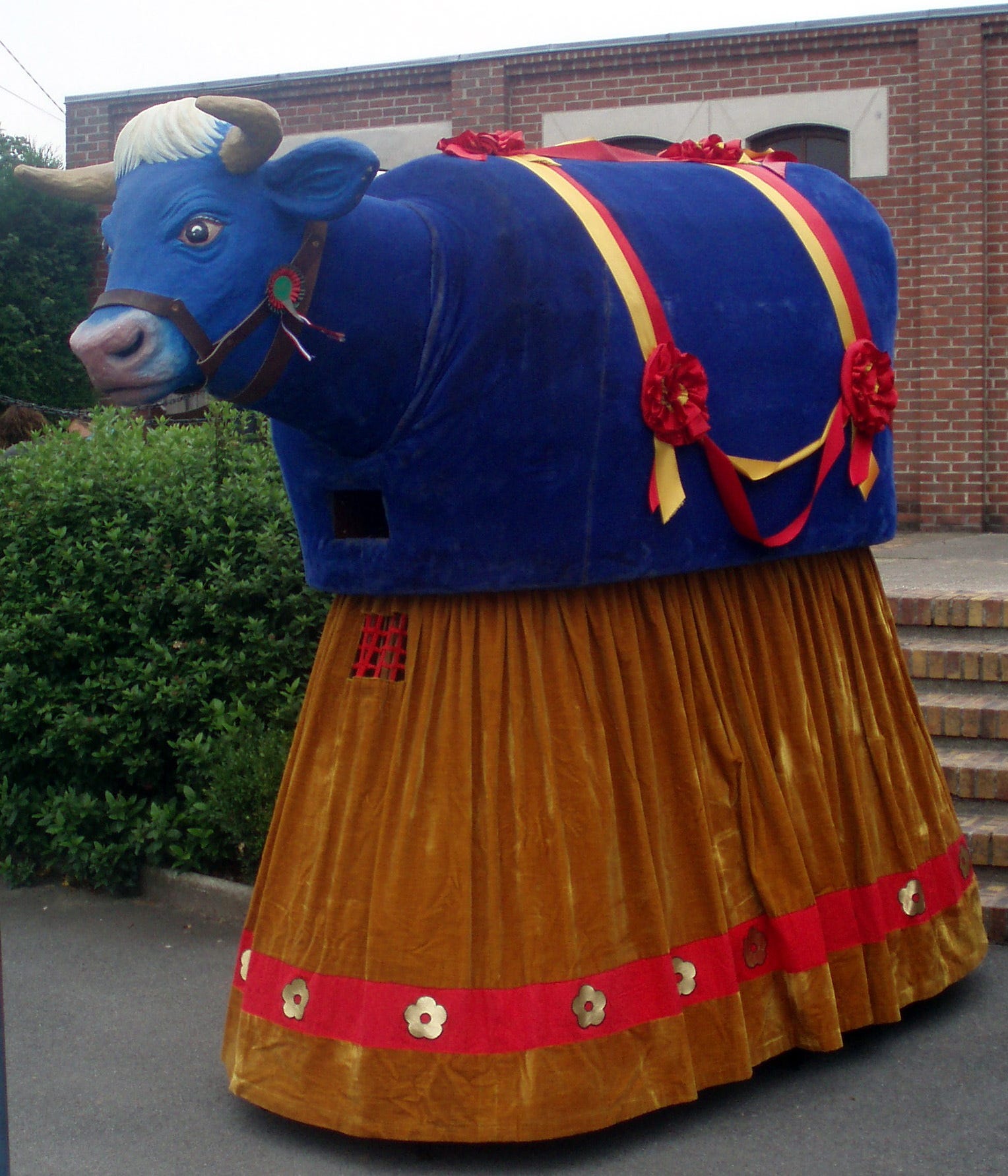
As we drove through the village, I glimpsed, from the corner of my eye, what looked like a life-sized bull, its hide bright blue. A long skirt covered its legs, and a large round hole gaped in the middle of its back.
“Did you see that?” I said.
“What?” said Marie Dominique.
“Nothing.” Who would believe it? I wasn’t sure I did myself.
The silence closed in again - broken shockingly by the rising howl of a chainsaw biting into wood. Ahead, a glow lit the sky, and we smelled wood smoke.
The football field was alive with light and activity. Tents, striped blue and white, were being raised. At one end, trees were piled, trunks and branches jumbled together, leafless. As men with chainsaws methodically severed short logs, others carried them to where flames rose from a slit trench the length of a cricket pitch, its sides lined with steel plates.
“Is already one hour burning,” explained a watcher, pointing to the men cutting and hauling wood. “They fill - then...” He made a pressing-down motion with his hands. “Become.... cendres.”
“Coals. And after that, how long?”
“Then?” He held up three fingers. Three hours, before the fire was ready.
For a couple of hours, we dozed in the car, not quite asleep, kept awake by the chainsaws’ howl. When we climbed out again, stiff and dishevelled, a crimson sun, fat as a pumpkin, was rising over unsown fields where cows moved uneasily in a white mist. Chilled, we drifted towards the heat that rippled the air above the fire pit.
Of the firewood, only a few branches remained. The rest had fed the bed of coals glowing at near white heat in the pit. Overnight, supports had been dragged into place at either end: square-section uprights of green-enameled steel, braced from four sides, bolted to wide metal bases, ready to assume the weight.
There was an atmosphere of the timeless. In another century, people like these - like us – had come here to watch a joust between armoured knights, or a hanging, or a carnival, with beer and games and mimed plays, and dancing.
Just then, men turned and looked over our shoulders, laughing. Marie-Dominique grinned. “Look at this.”
It was the blue cow I’d seen in the night. But now the upper torso of a man stuck out of its back, his feet hidden under the skirt. He wore a crimson tunic, and waved a wooden sword as he capered awkwardly around the field, defying the solemnity of the moment, playing the fool. A rider in a similar outfit, known as a “hobby horse”, is part of the team in the English Morris or Morrish dances. The further you left the city behind, the near the past became.
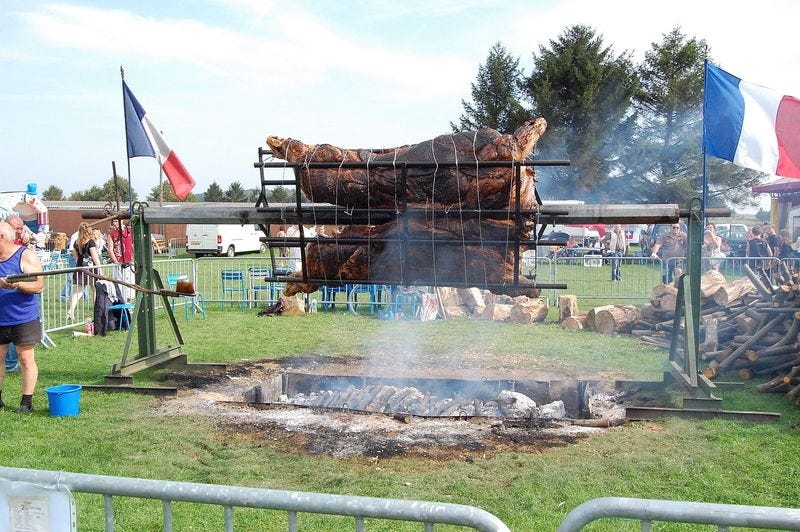
Beyond the tents, a motor coughed, then caught and roared in a throaty snarl. Gushing a plume of exhaust into the cold air, a tractor crawled around the corner of the tent. On two cranked metal arms, lifted high in front of the cab, rested the reason for our presence; a thousand pounds of flesh and bone.
The metal barriers were pushed back. Nobody spoke as the tractor moved out into the open and jolted towards us over the uneven ground. We who leaned on the railings around the pit, enjoying the heat, stepped back and, in unison, turned towards the incoming machine and its load. There was awe in the air, an awkward reverence. The blue bull ceased his dance and lowered his sword. If he had come to mock the animal at the heart of the event, to brag of our power in vanquishing him, this was not the time.
All our lives, we’d eaten meat. But that had been in fragments. To see the animal entire made us aware of kinship , of a shared nature as creatures of flesh that walked and ate and breathed and bred and died. The indignity of slaughter, of being skinned and gutted, of having head and feet severed, of being spread-eagled between steel grilles and transfixed by the octagonal beam of the spit reduced not a fraction his latent majesty. Antoine de St Exupery was right.“Perfection is achieved, not when there is nothing more to add, but when there is nothing left to take away.” This was still the beast matadors faced in the ring; the creature over whose back dancers had leaped in the palace of Minos; the animal Picasso drew as the embodiment of maleness; the Minotaur himself. And we were gathered to devour him.
At 11am, the mayor arrived to declare the Fete du Boeuf officially open. Ten minutes later, the tractor returned to lift the beast off the spit and carry it back behind the metal barriers, while we filed with five hundred others into the tent.
Seating was at backless benches, eight to a side, at long bare wooden tables. On my left, a man born in Portugal but working here for twenty years wondered why I was making notes.
“I’m writing a book. About food.”
“Why aren’t you back there?” he asked, pointing behind the tent. “With the butchers?”
“Is that allowed?”
He swiveled around on the bench. “Come with me.”
Outside, across a few yards of open space, a dozen men in aprons stood at tables under an open sided tent and sliced and hacked and trimmed. Off to the side, four women forked steaks from deep plastic dishes and slapped them on barbecues made from oil drums cut in half and filled with coals. The smoke and smell of sizzling meat filled the air.
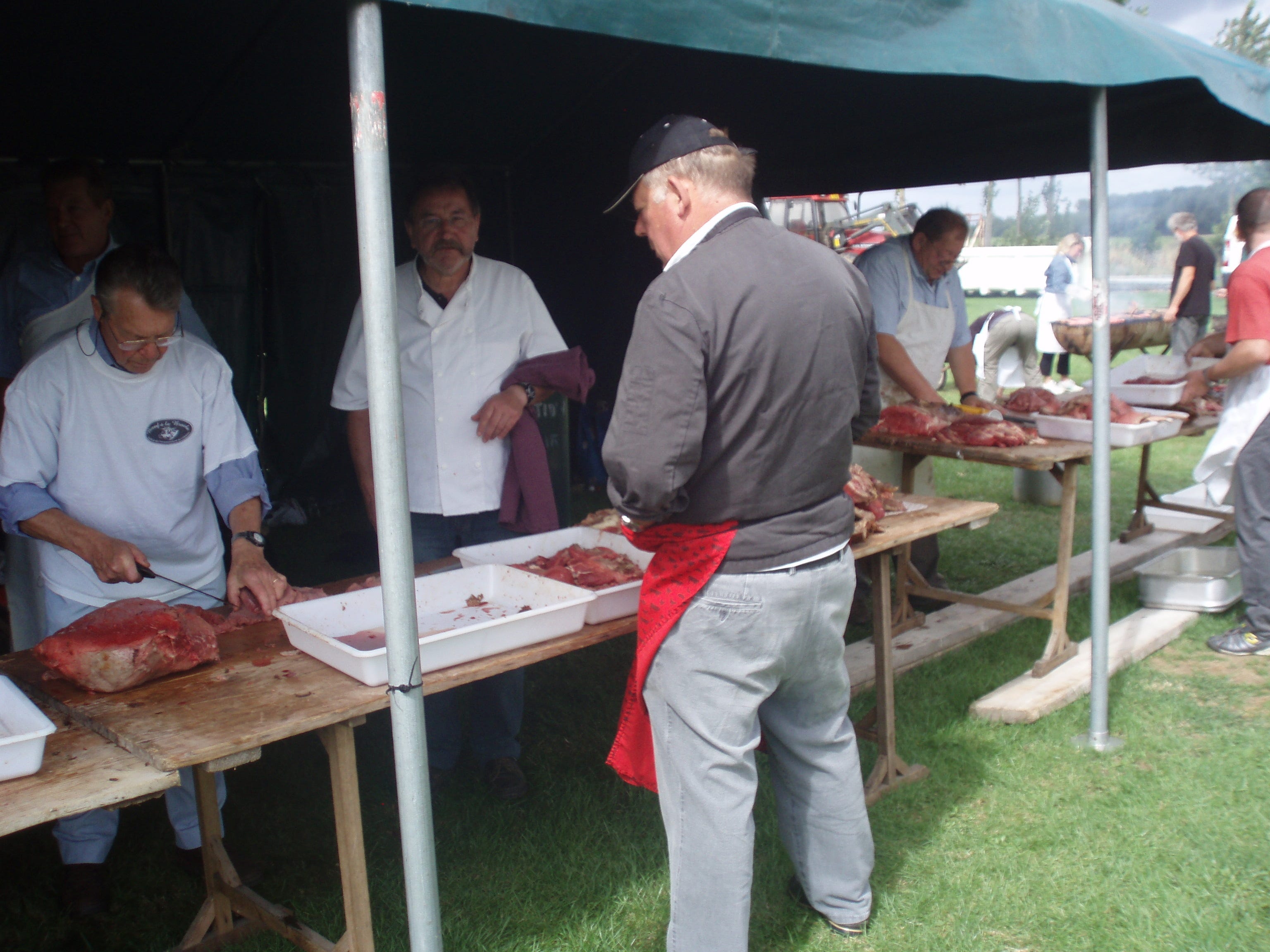
Bugnicourt. The butchers.
My new friend knew the butchers and they knew him.
“M’sieur’s writing a book. About food. He’s from Australia.”
“Australia? No kangaroos here, my friend,” said one. He held up a big fork with a steak impaled. “Only good French beef.”
“Kangaroos can be good eating,” I said. “The tail, for soup, and the…” What was the word for it? Fortunately Franglais came to the rescue. “…rumsteak.”
“You’ve eaten it?” one asked. Only a couple were working now. We were men, talking meat ; an important subject. Their subject.
“It’s good,” I said. “Lean. Like…la venaison.”
They nodded. Interested. Until one of the women returned with an empty dish, ready for more steaks. “Better get on,” someone said. “This guy won’t cut himself up. Good luck with the book.” He nodded towards my Portuguese guide. “Make sure you spell his name right.”
A few of the men grinned. He must have a reputation for pushing himself forward. As we walked back, he said, “He was only joking, you know. About the name.” A few more steps. “It’s Lucas, by the way. From Porto.”
I’ d worried the beef might be tough, but it was tender and tasty; as good as any I’ve had in a restaurant. With unlimited frites , jugs of a sauce made from the meat juices spiced with whole peppercorns, bowls of sliced baguette, cheese, salad, chocolate mousse…not bad for €11.
But the place….the ceremony….the people. How could you put a price on that?
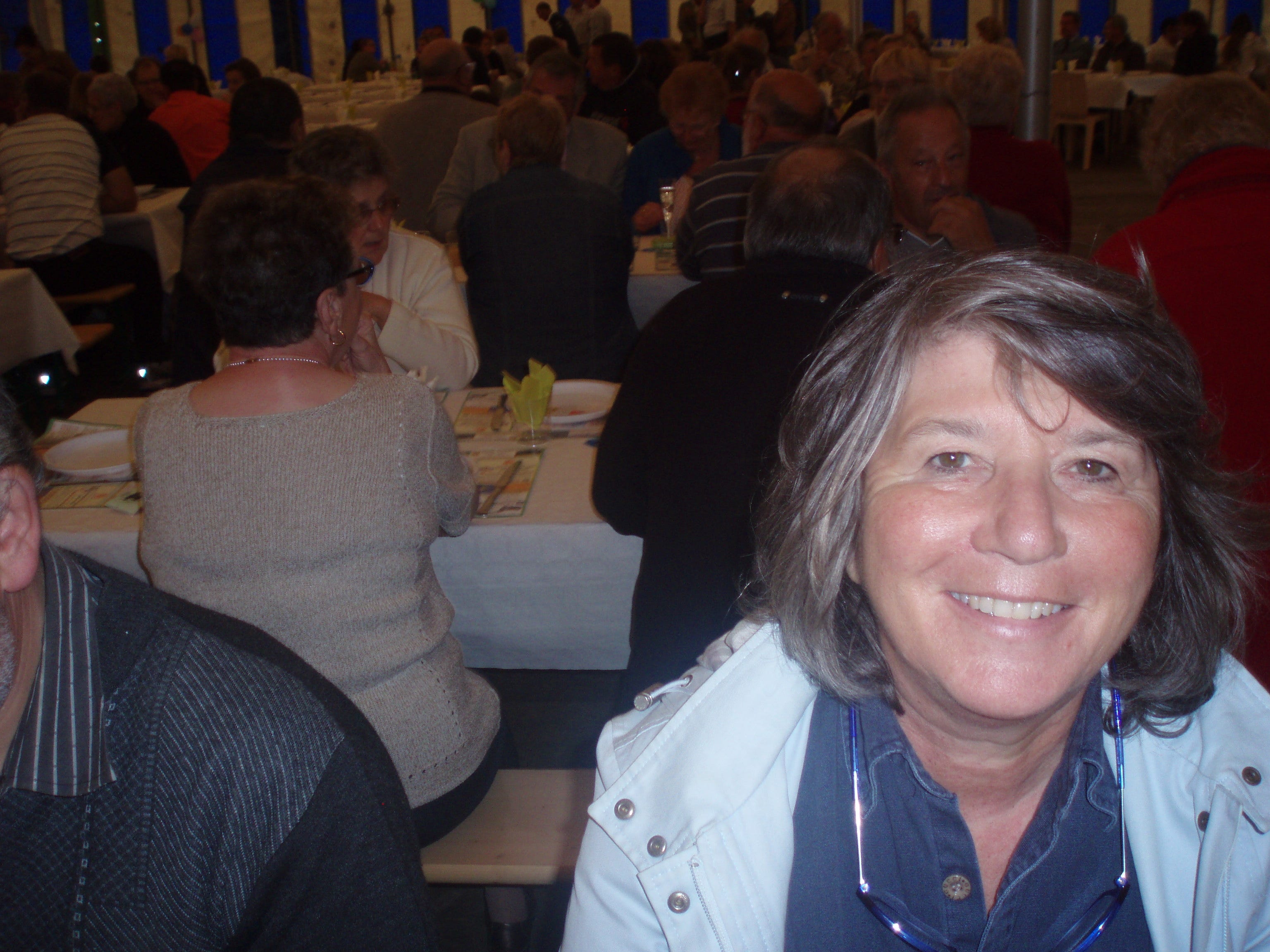
Marie Dominique at Bugnicourt.
Especially liked the note about the whole corpus of the animal reminding you of our kinship with other animals.
The washing-up alone.....