
ME AND FELLINI
LOOKING FOR FEFE

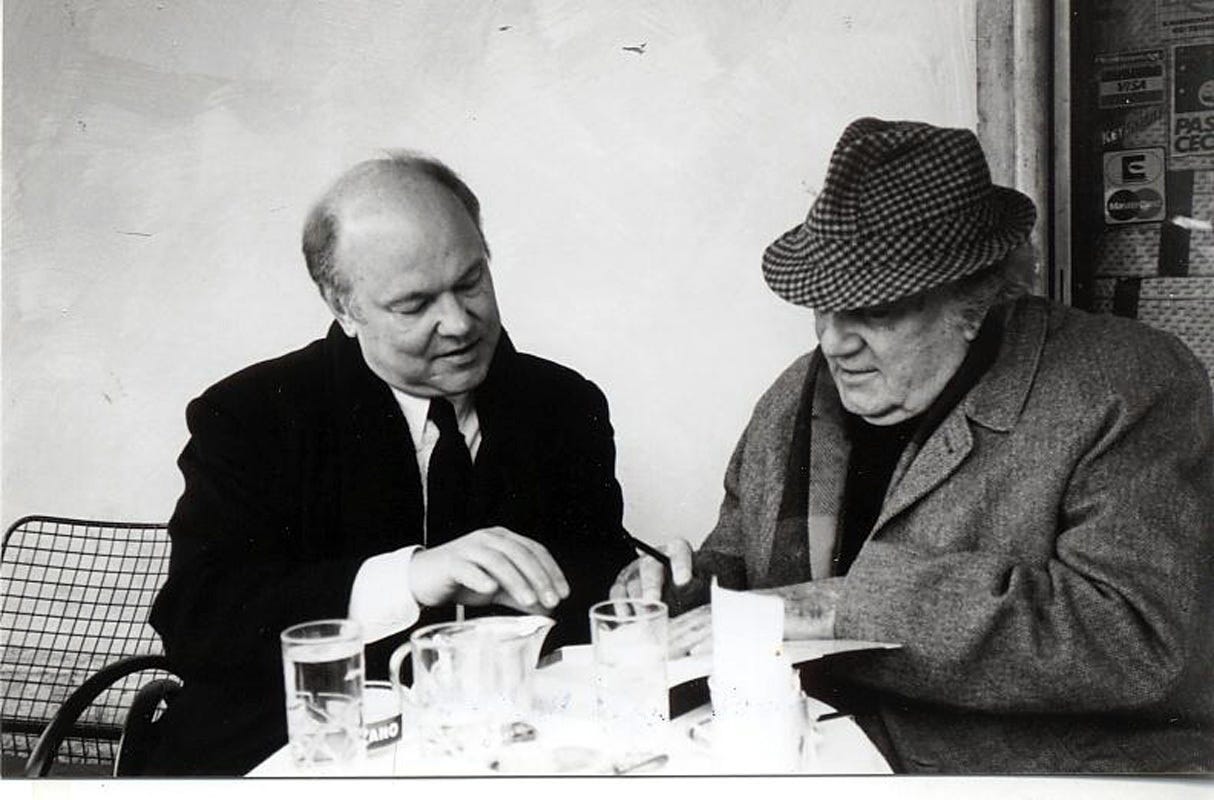
In a recent post, I mentioned how I came to write the biography of Federico Fellini. A few people have asked for the background, and in particular the story behind the photograph above, of myself and the maestro at the cafe Canova in Rome. If what follows seems improbable, imagine what it was like to live it.
On a chill morning in February 1990, I sat with my new French fiancée in her tiny studio on Place Dauphine, a triangle of swept sand and bare chestnut trees within sight of Notre Dame and the Louvre. With an eye to its shape and position at the very groin of the city, André Breton, pope of the Surrealists, named it le sexe de Paris. From her window, one could see the office on Quai des Orfevres formerly occupied - had he existed – by Commissaire Jules Maigret. Anyone hoping to make his literary mark here had his work cut out for him.
For the moment, that person was me. Three months ago, I’d been happily at home in Los Angeles. Then romance arrived in the person of Marie Dominique, and I found myself in Paris, and unemployed.
“I can’t do what I was doing in LA,” I said. “No screenplay work here. And there are already more than enough journalists covering the French film scene.”
“Mmm,” she said.
“And though I could probably get some radio work from the BBC in London, the money is so poor….”
She nodded thoughtfully. The wind blew a few early tourists across the park. They looked as desolate as I had begun to feel.
“Perhaps...” she said, ashing her cigarette – like most Frenchwomen, she could make this gesture look as if drawn by Matisse – “...a book?”
It had been years since my last book. Screenwriting, journalism, teaching – the small change of literature – kept me comfortable, but also unadventurous.
“I suppose. What sort of book?”
“About...” The cigarette again. “...the cinema?”
“Mmmm….” Now I was doing it. Perhaps I should take up smoking too.
I tried to concentrate. Was there even a market for film books? Occasionally someone sent one for review, but they were dull stuff.
However...
A few months before, I’d read a life of director Luchino Visconti. It concentrated on Visconti as a person, not just his films. I finished it feeling I’d met this talented but infuriating man.
Another Italian film personality played a role in Visconti’s story; an adversary, without his aristocracy or education, but blessed with a unique quality of the irrational. Rafael Sabatini began his novel Scaramouche by writing of his swashbuckling hero “He was born with the gift of laughter, and a sense that the world was mad.” Well, this man had that sense in spades.
“What about Fellini?” I said.
“Oh?” Marie Dominique raised her eyebrows. “I thought....an American…. but….Fellini. Yes. well, why not? Where was he born?”
“Somewhere along the Adriatic, I think. Rimini?”
She crushed out her butt in the chipped Lalique cendrier. Smoke blended with her perfume in a way that made me feel urgently that we should go back to bed.
“It might snow,” she said, staring into the sky as into a crystal ball. It had the hard grey of a dead TV tube. “Best not to go today.”
I blinked. “Go where?”
“Rimini,” she said, “évidemment.”
The storm that followed us across France waited to dump its snow until just as we reached Mont Blanc. Dwarfed by sixteen-wheelers, we let ourselves be swallowed by the sloping eleven-kilometre tunnel. In the ski resort at the other end, a motel with the chilly ambiance of a cancer clinic granted us a room. Looking for dinner, we trudged into town. Porsches crawled by in the slush, snow chains clanking, while, inside, diamonds winked.
All next day we scooted down mountain passes, racing sleek green torrents and careering through wooden villages, their houses warped and stained grey by weather, then across the marshy plains of Romagna - until, in the late afternoon, Rimini materialised out of the sea mist.
Shut tight for the winter, the town was a metaphor for desolation. The Adriatic, flat and grey as a zinc roof, lapped flaccidly at a beach lined with wooden huts bolted tight. Shutters masked the facade of the Grand Hotel, and cats skulked around the stone-flagged squares.
But everywhere, one saw Fellini. In Amarcord, he and his friends spied on meaty German frauen undressing in these huts. Fellini even dreamed of such a woman carrying him like a baby into one of them. Here, in 8 1/2, they gaped at the mountainous La Saraghina, The Sardine Woman, as she shook her vast body. On the hotel terrace, they mimed dancing with the town vamp, Gradisca - who, in one of its wide beds, preserved Rimini’s reputation for hospitality by offering herself to a bored visiting prince with the politeness that earned her nickname: “Principe, gradisca - Highness, help yourself.”
But traces of the man were elusive. Even the place where he was born. Eventually Marie-Dominique - she spoke Italian, naturellement - asked at a tiny photo shop.
“The Americans bombed us in the war,” the owner said. “I think it was destroyed.”
Unexpectedly, he told his eight-year-old son to mind the shop, led us down the street and around the corner to a small apartment block. A buzz brought a woman to the second-storey window, her head wrapped in a scarf.
He called up “Some people from Australia want to know where Féfe was born.”
“Bombed,” she said. “It was up the street.” She waved a duster. “Don’t they do housework in Australia? Tell them to come back this afternoon.”
As she shut the window, the man pointed to the name on the doorbell. Maddalena Fellini Fabbri. “This is Féderico’s sister.”
We met her that afternoon, a tall, commanding woman with the same wide shoulders and tapering ankles as her brother.
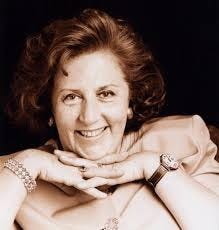
Maddalena Maria Fellini Fabbri
“A book about Fefé?” she said, with unexpected acerbity. “Why? He’s a pain in the arse.”
“But a great director, surely.”
“I suppose.” She brightened. “I’m in the movies too, you know. I was just in a film. Directed by Tonino Guerra.”
“…who wrote And the Ship Sails On - and Ginger and Fred.”
“...and L’Avventura for Antonioni and Nostalghia for Tarkovsky,” she said crossly. “My brother’s not the only director in the world, you know.”
She shoved a cassette into her VCR. “I shouldn’t be showing you this…” But try and stop me.
It was a Roman talk show. All the guests were relatives of more famous people.
“Has your brother seen your film?” the host asked Maddalena.
She looked grim. “You’ll have to ask him.”
“Well, we’re going to do just that.” He reached for his desk phone. “He’s on the line now. Did you see La Domenica Specialmente, maestro?”
Even through the phone, Fellini’s light, almost feminine voice was unmistakable.
“Ah, not yet. I walked past the cinema, but the times were not good. Then, when I went back, the program had changed.”
“I sent you a cassette,” Maddalena interrupted.
Fellini didn’t falter. “Yes, that’s true, cara Maddalena. And I mean to sit down tonight and watch it. Unfortunately, I leave tomorrow…”
Back in her flat, Maddalena ejected the cassette.
“You see what he’s like. I don’t talk to him anymore. I’ll give you his number in Rome, but really, you’re better off talking to Giulietta. That’s what I do.”
“And what do you think of his films?”
She shrugged. “Some are good. But most are ridiculous. These grotesque people he invents.….”
The doorbell rang. “Ah, some friends. For coffee. Scusi.“
At the door, we stood back as her guests filed in. First, a dowager dressed for a society wedding of forty years ago, in a wide hat with a black veil, and yellowing kid gloves tight across bony knuckles to hide her liver spots. Behind her, a priest, fifty but hoping to pass for thirty, corseted, with a blonde perm, lacquered nails and a touch of rouge. Lastly, an overweight femme fatale, doughy breasts spilling out of a sequined gown, already eyeing the plate of cream cakes.
Over their shoulders, the family photo of Fellini stared down from the wall with that trademark look of ironic amusement.
“You see?” I could hear him saying. “Did I exaggerate?”
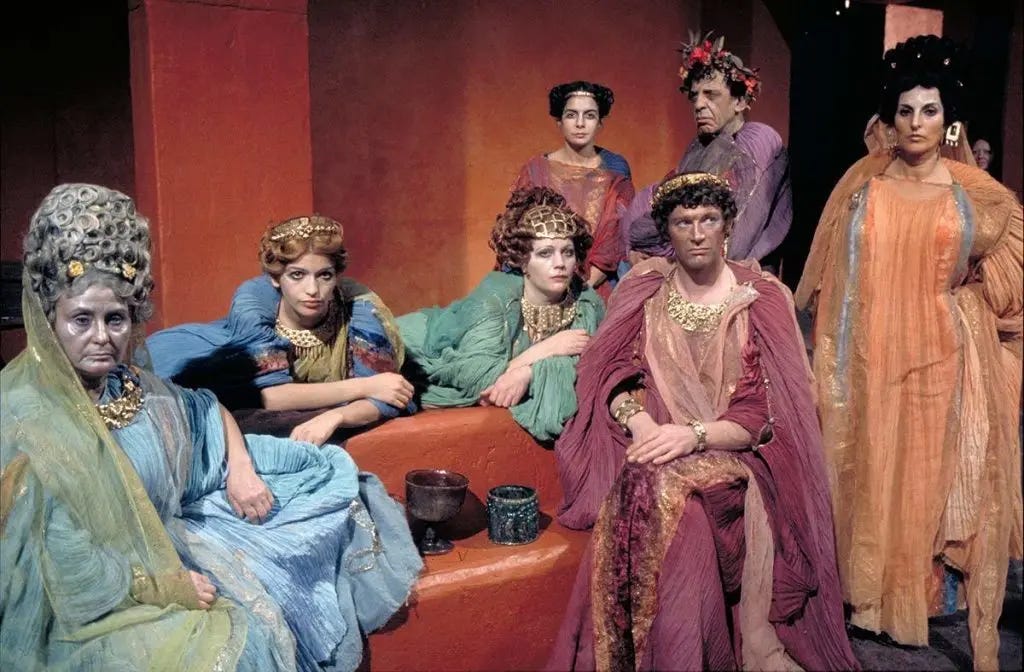
A scene from Fellini Satyricon.
A year later, I took the overnight train to Rome, ready now to call him. Perhaps I should have rung from Paris, but it felt right to roll the dice only once.
In twelve months of research, I’d learned Fellini’s habits. How he and Giulietta Masina lived in the same building on via Margutta, but in separate apartments. How he slept little, and rose before dawn to work.
Was 8am too early? “De l’audace, encore de l’audace, toujours de l’audace,” said Danton, one of my new heroes.
I punched in the numbers.
“Pronto”.
It was the voice of an old woman. Not Giulietta. Nor a secretary. Who?
“Er....can I speak to Signor Fellini?”
A long pause. Then, in awkward English, “Who is this?”
“He doesn’t know me. His sister gave me his number,” I waffled. “I’m Australian…writing a book…”
“Momento.”
Another pause. Then Fellini came on the line, and, in that familiar fluting voice, politely brushed me off.
“Ah, yes. I like to see you but am very busy. I begin a new film. Also I am sick…the hospital…an operation. And it is the holidays…”
I refused to give up without a fight. Everyone to whom I’d spoken had said “...and do please give him my regards.“ Now I enlisted them. “Your friends in Paris and London asked to be remembered. Alain Cuny, Marika Rivera, Dominique Delouche, Magali Noel, Freddie Jones...”
But I could feel him slipping away. “I don’t know...perhaps...call my secretary....”
Then just the hollow buzz of a dead line.
Well, maybe it wasn’t going to happen. It had always been a long shot. Half fearing this, I’d set up other interviews. By late morning, I was up in the hills, talking to Gerald Morin. Solemn, thin, with long pale hands, he still looked like the Jesuit he’d been before becoming Fellini’s secretary, assistant and – as the atheist Fellini liked to say – confessor.
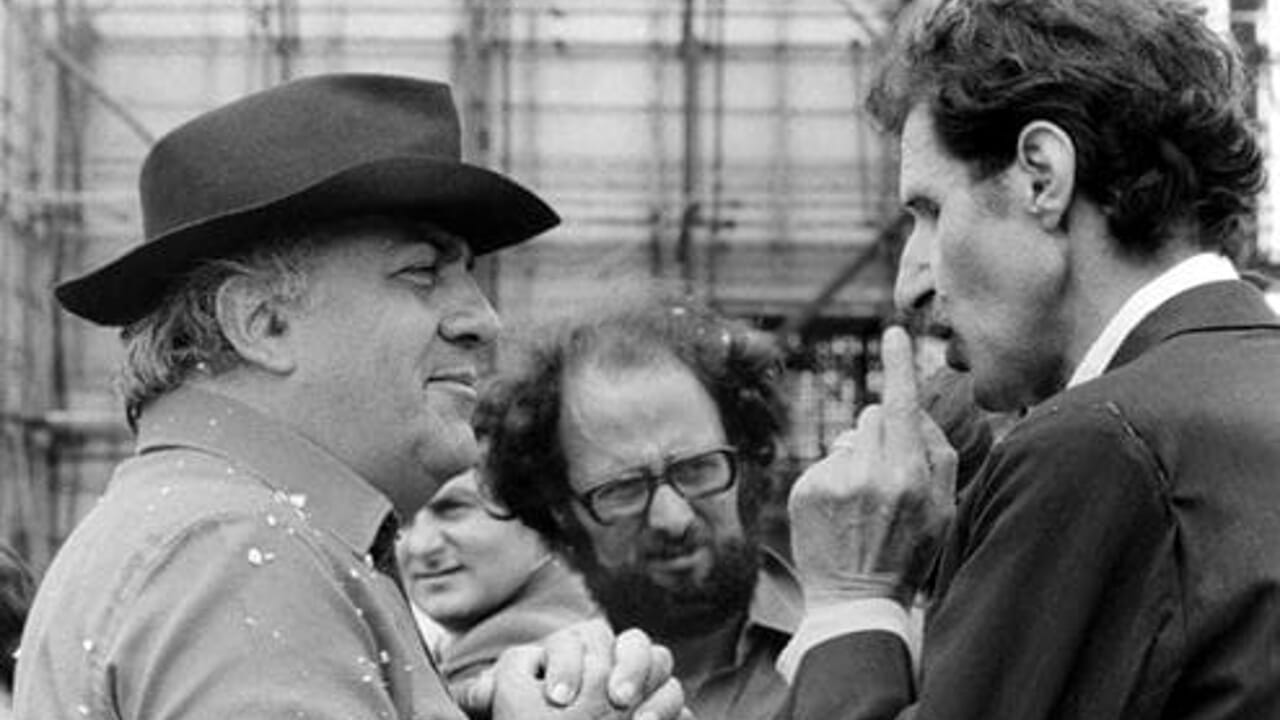
Fellini with Gerald Morin (right)
“I rang Fellini this morning,” I said. “An old lady answered. Who’s that?”
“Oh, it’s Fellini. If you call before his secretary arrives, he puts on that voice.” A rueful shake of the head. He looked embarrassed at having betrayed even so small a secret. The Jesuit die bites deep.
I left him just after eleven. Far below, the Coliseum and Piazza Navona wallowed in phlegm-coloured smog. Up here, the air was clear enough to see that there was nothing to see, except a Hilton Hotel. I walked past the line of taxis, doors open, drivers dozing under copies of La Stampa, and through an air-conditioned lobby to the desk of a concierge with the thin-lipped smile of a Machiavelli.
“A place around here to eat?” He made a face. “There are none, really. You should go down to Prati.” He drew a slip of paper towards him and wrote some names. “All of these are good.”
I woke a cabby, who grudgingly folded his paper and drove for twenty minutes before stopping on a narrow street lined with restaurants.
“This one, Da Bruni…” He pointed to the first name on the list. “…is…” He waved at the street in front of us. “....but I cannot…” The street, it seemed, was one-way.
I got out. On every corner, waiters were setting out tables and umbrellas. But it was barely noon. A breeze blew. The sun was warm. And I felt like a walk. Da Bruni looked nothing special. No tables outside. No menus displayed. I pushed open the door and went in. Few Romans ate this early, and the place was empty, except for two men at a table by the wall.
One of them was Fellini.
My first reaction was disbelief. Surely this man just looked like him. But as I watched, he rose to go to the men’s room, and the silhouette - the wide shoulders and delicate feet, the car coat, the tweed hat, the scarf draped over his shoulders - was unmistakable.
Dizzy with excitement, I waylaid him on his return. “Sorry to bother you… rang this morning… just talking to Gerald Morin… concierge… cab...incredible coincidence…”
His pouchy eyes regarded me without surprise - as if such things happened all the time. Which they did, I found later. A disciple of Carl Gustav Jung, Fellini embraced the belief that a coincidence was not chance but “synchronicity”; a glimpse of an unseen pattern to which we were all subject.
I watched him mentally change gears, perceiving me anew, no longer an incoherent foreigner but someone whom the universe desired him to know.
“Ah, yes,” he nodded. “The Australian. And you know Maddalena? Bene, bene. Allora...”
His look around the restaurant encompassed the existence of other commitments, but in a way that made us intimates; conspirators. You know how it is, my new and valued confrère. To you, I need not explain.
“Can we meet tomorrow? I am always …”
“…at the Café Canova,” I said. “Piazza del Popolo. Yes, I know.”
He nodded, unsurprised that I was aware of his habits. Just more synchronicity. “Allora, domani, mio amico...”
He shuffled back to his table. I stared after him.
Mio amico?
The next day, he looked up with a smile as I crossed the piazza. Before the first espresso, he had begun to dictate. “You must talk to Liliana, my secretary. She knows all my secrets. Here is her phone. And Marcello....But I think he is in Paris...oh, you are living there? Bene, bene...” Synchronicity again.
Any biography subject can stop a project dead simply by advising friends not to talk to you. With Fellini, the reverse was the case. People actually rang, volunteering their help. One of them showed me around Cinecittà. Uncomplaining, a crew opened Stage 5 – the Fellini stage – and lit its vast emptiness, revealing its corroded metalwork, the splintered wooden floors. Meeting my eyes, they shrugged. There is no shame. It is what it is. You understand this, for you are one of us. From among enough statues to furnish a thousand palaces, they unearthed a golden effigy of Christ – the very figure carried by helicopter across Rome at the opening of La Dolce Vita. In what other way could they help? For Il Poeta, nothing was too much trouble.
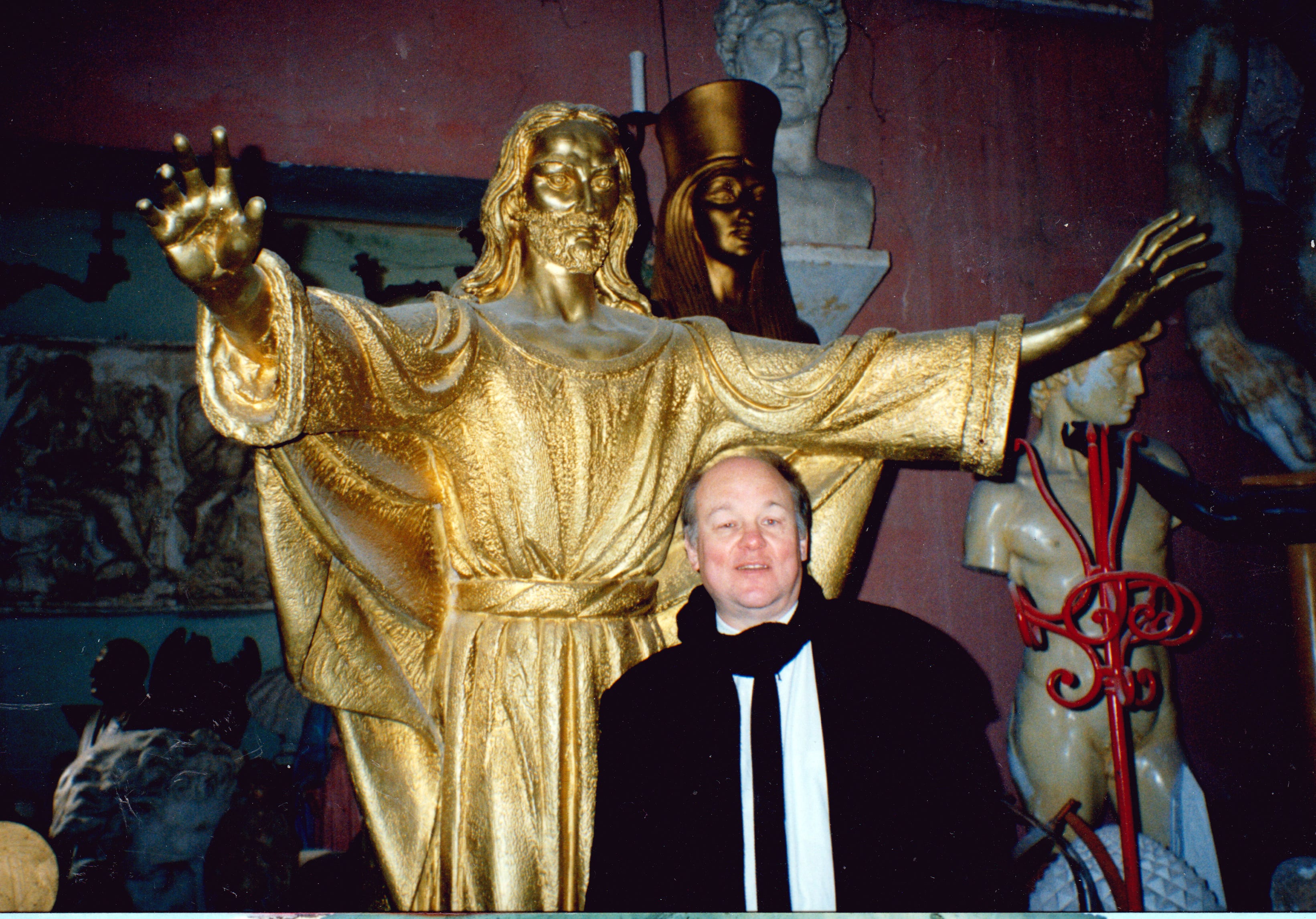
Over expressos in cafes along the Via Veneto and in the lanes of Trastevere, I met more such people. In pensiones and tiny studios, they waited for the notice in Corriere della Sera. “Signor Fellini is making a new film and will be happy to meet anyone who wants to meet him.” Only then would they come to life, hungry for those few days or weeks close to him.I felt it myself, sitting in the Canova as he spun his nets of fantasies and lies. Where was he actually born, for example? There were so many stories...
“Oh, caro John, who knows?” He watched a flight outward bound from Fiumicino score a white line across the polluted blue. “Perhaps I was born in a plane...”
In 1993, a few months after the biography appeared, Fellini entered a Zurich clinic for heart surgery. He didn’t survive. At 73, the man was dead, but that was just a detail. For someone who followed the teachings of Jung, there were only beginnings.
Fellini rarely submitted to formal portraiture but he relented for French photogapher Eric Fayolle.
“How are you going to show me?” he asked. “Young? Old?”
For Fayolle, there could be only one answer.
“Immortal,” he said.
Fellini nodded in satisfaction. “Bene, bene.”
Immortal indeed.
Thanks, David. There's a US edition too but it omits the last chapter, though most of the material for that is contained in my recent post. There is/was an ebook version, which I can send you as a pdf if you don't mind reading paperless.
Writing biography involves quite a bit of detective work, so I suppose the comparison is apt (though Marie Dominique, unlike Madame Maigret, is not much of a cook.) Incidentally Simenon and Fellini were friends, and carried on a long correspondence. Simenon was chairman of the jury at the Cannes Film Festival when LA DOLCE VITA was shown and was responsible for it getting the Palme d'Or.