
PLAY IT AGAIN, MARCEL.
LET'S HEAR THAT CHEAP OLD TUNE AGAIN.

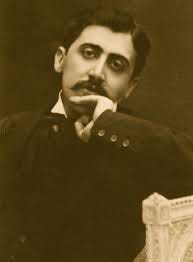
Marcel Proust. “Now how does it go again? Dum de dum de dah….”
In Noel Coward’s Private Lives, the chance hearing of an old song brings back to Elyot the painful memory of a love he assumed dead. “Strange,” he muses, “how potent cheap music is.”
I don’t know about “cheap” but incongruous scraps of music often move me, as I’m sure they do you. Still, we’re in good company. A “little phrase” from César Franck’s Sonata in A Major for piano and violin haunted Marcel Proust. To remind himself of how it went, he summoned a string quartet to play it. He slept by day and worked at night, so they had to come at midnight, but he paid well. They even complimented him on the cork=covered walls that muffled noise from outside.
“We’ve never sounded so good,” said the first violinist. “Particularly not at three in the morning,” added the viola player sourly.
Earlier this week, because we are in the area again, I had a vivid reminder of a warm day in the old harbour town of Rochefort almost thirty years ago.
Our daughter Louise was then about five or six. We’d just parked in front of the Musée de la Marine. While we sorted out hats and handbags, she climbed onto one of the rusty cannons in front of the Napoleonic building and idly began to sing – at which I was immediately moved to tears.
I knew the song. It was the traditional Celtic folk tune Waley Waley, sometimes called The Water is Wide. She, however, sang it in French, as I had never heard it.
In his play The History Boys, Alan Bennett writes, “The best moments in reading are when you come across something – a thought, a feeling, a way of looking at things – which you had thought special and particular to you. Now here it is, set down by someone else, a person you have never met, someone even who is long dead. And it is as if a hand has come out and taken yours.”
This was such a moment, a twitch on a thread connecting me to another life in rural England, and even before that, to a childhood on the far side of the world. It affirmed a shared culture that can unite the least likely people.
I asked Louise if she remembered the song. She did.
Proust wrote that “the field open to the musician is not a miserable stave of seven notes, but an immeasurable keyboard (still almost entirely unknown) on which, here and there only, separated by the thick darkness of its unexplored tracts, some few among the millions of keys of tenderness, of passion, of courage, of serenity, which compose it, each one differing from all the rest as one universe differs from another, have been discovered by a few great artists who do us the service, when they awaken in us the emotion corresponding to the theme they have discovered, of showing us what richness, what variety lies hidden, unknown to us, in that vast, unfathomed and forbidding night of our soul which we take to be an impenetrable void.”
Or, if you prefer, “Strange how potent cheap music is.”
Beautiful moving post. It reminded me of the passage in William Styron’s memoir, Darkness Visible, when he hears a piece by Bach that convinces him life is still worth living. Also of Tolstoy saying peasant songs are the best. Thank you for the reminder of music’s profundity.
A French version is included in the posting. If you weren't able to access it, here is the YouTube link.https://www.youtube.com/watch?v=BnPU6F_HCUE&list=RDBnPU6F_HCUE&start_radio=1