
REMEMBRANCE OF PROUST PAST

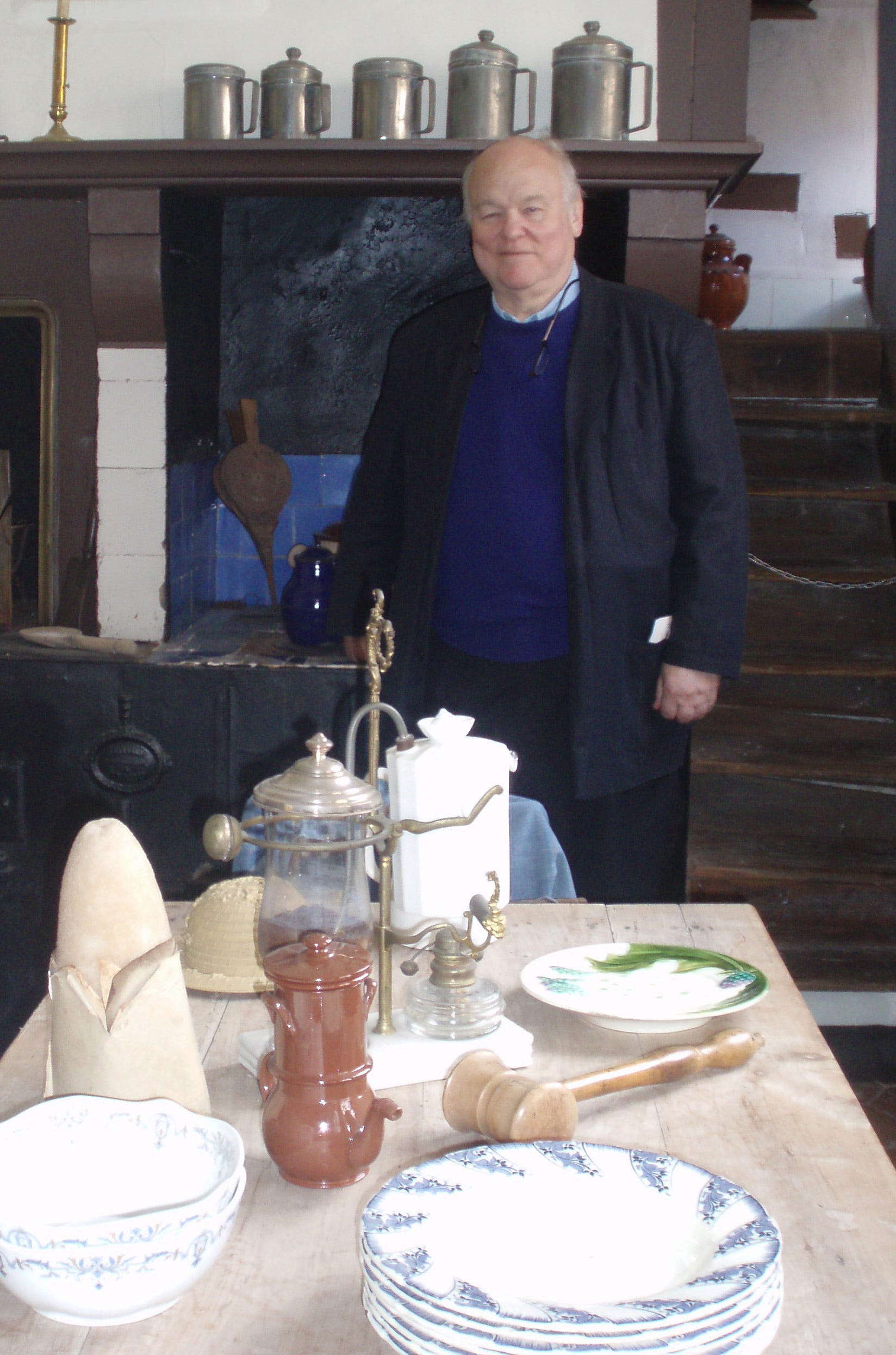
“Madeleine, anyone?” In the kitchen at Proust’s home, Illiers-Combray.
On this day in 1922, Marcel Proust drew the last of innumerable painful breaths. He was only 51, but had already written the greatest of all novels.
I read the first volume, Du côté de chez Swann, when I was about fourteen ; not in French, of course, but as Swann’s Way, in C.K. Scott-Moncrieff’s translation. Philippe Julian’s pen and ink illustrations suggested how the characters might have looked but I didn’t care. It was the words I loved.
Later, some of us made a film inspired by him, trying in a few minutes to capture some of the book’s spirit in another culture under a different sun. We called it After Proust. It won a certain baffled success – undermined by the tendency of almost everyone who saw it to mispronounce his name “Prowst”.
Forty years later, two hours after leaving Paris, our two-car train subsided to an exhausted halt and my daughter Louise and I stepped out at Illiers, the little town where Proust lived as a boy with his aunt, and to which he often returned. There wasn’t even a platform; just a stretch of asphalt and the unmanned station. Across the tracks, beyond a field of weeds, some derelict brick buildings slumped, apparently held up by the vines that wreathed them. The flat crack of a shotgun carried across the fields; hunters, out for rabbits in the stubble. Otherwise there was no sound at all.
A statue might have been asking too much, but they could have erected a sign, “Home Town of Marcel Proust”. None, however, was forthcoming. In 1971, for his centenary, they did at least re-christen the town Illiers-Combray, adding the name Proust invented for the book, but after that, enthusiasm waned. Instead, the square outside the station was dominated by an obelisk commemorating the dead of the 1914-18 war. Perched on the top, a bronze rooster, the Coq Gallois, symbolised France’s cocky fighting spirit. It was a silent statement of relative values. Literature was all very well but national pride, la gloire, came first.
Thirty minutes later, at a table on the deserted central square, Louise sipped a eau à la menthe and I drank a beer. I’d assumed we were the only strangers in town until an English family colonised the next table. On the strength of a single coffee, all four members disappeared, one after the other, into the dark interior.
“Their toilet seems to be popular,” I said.
“At least it’s open.”
Not much was. At the sparse visitor’s center, a stony-faced lady handed us a map. The former home of Proust’s great aunt, now a museum, was closing just as we arrived at mid-day.
“When do you re-open?”
“Two thirty.”
The gardienne’s look suggested I’d asked a silly question. Two and a half hours for lunch? I recognised the same statement of principles that mandated the war memorial. Marcel Proust was only a writer, people! Get serious.
For two hours, we explored anyway. Illiers had been modestly prosperous once, but those days were gone. Shutters had been up for decades at the Bains-Douches Municipaux, where, before home plumbing, one could take a weekly bath. Nor were there any women at the public laundry where wives and housekeepers once knelt on stones around the communal pond, gossiping as they pounded the clothes clean.
At 2.30 sharp, the gardienne of the museum, more cheerful after her lunch, unlocked its black metal gates. The little house had barely changed since Proust lived here between the ages of six and nine, at the end of the 1870s. In the kitchen, simple country pots and pans covered the table. Climbing the narrow, winding wooden stairs, we dipped our heads to pass through low doors, smiled at the narrow beds, the flowered wallpaper, the faded oil paintings; all just as Proust described. Only the attic was different. It now contained a photo gallery of family and friends, a menagerie of bushy beards, extravagant hats, and men in stiff collars glaring at the camera. (If you smiled in those days of long exposures, it tended to come out as a ghastly grin.)
Finally, we stepped into Léonie’s bedroom. On the table next to her bed, in a glass case, like holy relics, sat a white ceramic tea pot, a cup, saucer and spoon, a dish of dried lime leaves, a bottle of Vichy-Célestins mineral water, and a delicately fluted madeleine.
Louise pointed to the mineral water. “Vichy-Célestins. The kind mamine likes.”
She was right. Her grandmother – my mother-in-law, Claudine - shared an older person’s preference for fizzy mineral water. And both slept in almost identical beds, in the Second Empire style, with the same scroll-backed wooden headboards, in a room, as Proust wrote, “of that country order which (just as in certain climes whole tracts of air or ocean are illuminated or scented by myriads of protozoa which we cannot see) fascinate our sense of smell with the countless odours springing from their own special virtues, wisdom, habits, a whole secret system of life, invisible, superabundant and profoundly moral, which their atmosphere holds in solution.” I was close to tears.
It surprised me how serious an interest Louise took in the house. Confident I knew everything of importance, I’d refused the sheaf of documentation offered by the gardienne, but she took it, and referred to it as we walked, quoting what he wrote about the wallpaper, a painting, the tiny orangerie, no bigger than one of the bedrooms, at the bottom of the tiny garden . She had grown up with Proust and “done” him at school. As part of her patrimoine – her cultural heritage – he was worthy of respect, like Balzac, Zola, Gide. But worth missing lunch for? Not so sure.
My appreciation was different. For me, the visit was sacramental, like taking the waters at Lourdes. It was enough to sniff the air, smell the dust, stand in the little garden and look up at the windows through which he’d gazed a century and a half ago. He had been here. He’s here still.
Thanks, Lucy. It was a pilgrimage, in its way: obviously my Catholic education still has some effect.
Lovely vivid article. It sounds like a true literary pilgrimage John.