
SHOPPING WITH THE HEMINGWAYS
Where did the Lost Generation find their 57 Varieties?

Anyone who reads my posts will know that I’m one of those rare Australians who doesn’t care for the national beverage, beer, but prefers the imported vice of tea.
My taste for the reviving leaf even survived living in the United States, where a demand for tea yielded a cup of tepid water and a sachet which, with repeated dunking, grudgingly yielded a yellow fluid resembling a urine sample.
I never thought to experience a tea deficiency in France but with Britain leaving the EU and Marks and Spencer closing its stores, my supply of extra strong tea bags terminated abruptly. Since then, I’ve been ordering on line from establishments that call themselves British Grocery Stores and the British Corner Shop but are based in places like Obergurgl.
How did Brits get their tea back in the ‘twenties? The most likely source was J. Hazard, the largest grocery in “the Quarter”, as expats like to call the 6th arrondissement. Occupying half a block on Boulevard Montparnasse, close to the intersection with Boulevard Raspail, it announced prominently over the door “English Spoken.”
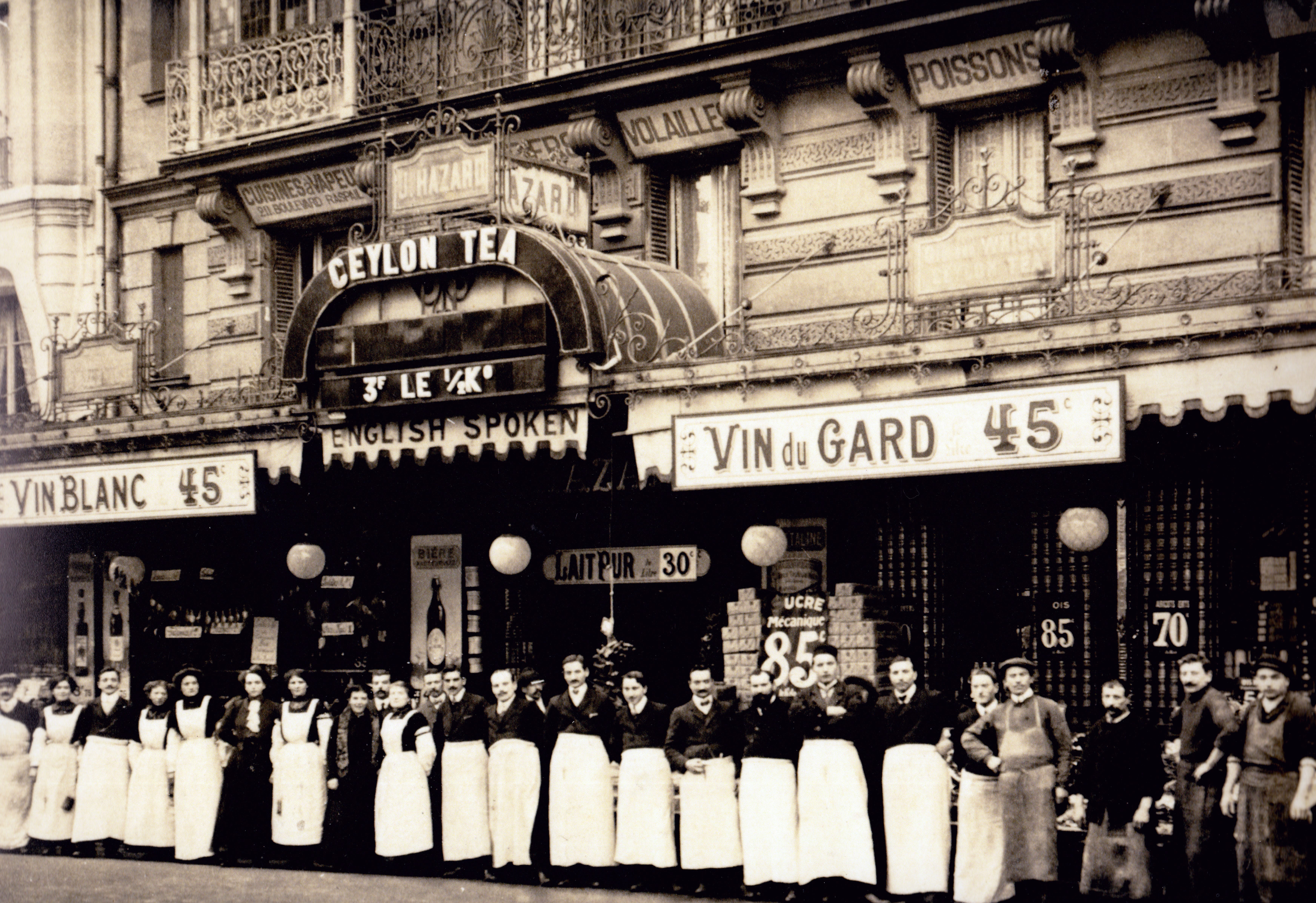
Its stock reflected the district’s racial mix, though naturally no right-thinking French person would touch this foreign rubbish. “Americans find here their grapefruit, as little like a lemon as a watermelon resembles a cantaloupe,” sneered Guillaume Apollinaire (who was actually a Pole.) “Russians find those Apples of Paradise [i.e., pomegranates] that resemble [giant] bigarreau cherries, and the Hungarians their meats and sausages spiced with paprika.” And , for the British, the Ceylon tea prominently advertised, next to Vin blanc and lait pur, at 3 francs the half-kilo.
Few expatriates actually shopped at Hazard, or anywhere else. For that, they employed a maid of all work known as a femme de ménage. Servants are the dirty little secret of les années folles. Waiters, nannies, concierges and housekeepers were as essential to the foreign community as Chinese workers to the building of America’s railroads. Without them, the table at Hemingway’s moveable feast would have been bare.
The cheap franc made home help accessible to the poorest expatriate. When, at the end of 1922, the Fitzgeralds hired Lillian Maddock as nanny for their daughter Scotty, Zelda gloated that they paid her $26 a month, compared to the going rate of $80 in the United States. Alice Toklas made a fuss of her cooking skills but she and Gertrude Stein always employed a cook.
Even when Ernest and Hadley Hemingway lived in two rooms on rue du Cardinal-Lemoine and scraped along on $1000 a year, they could afford a housekeeper. Her name was Marie Rohrbach, the wife of a retired soldier. She walked the kilometre every morning from their home on Avenue de Gobelins, made breakfast, stayed to clean house, washed and ironed clothes, shopped, prepared lunch, scrubbed and polished, then walked back to do the same things for her husband.
Without the benefit of labor-saving appliances, her work was punishing. She ironed with heavy flat-irons heated on the stove and scrubbed floors on hands and knees with a stiff brush, then polished them by shuffling through the rooms with rags tied to her feet. In old age, both her legs would be amputated, partly the result, Hadley believed, of such grinding labor.
After the birth of John, aka Bumby, Marie became his nursemaid. The Hemingways were often out of town, so during holidays she took him back with her to the family home in Brittany. In later life John said he saw more of her than he did of his actual parents. She doesn’t get a mention in A Moveable Feast, though, at the end of 1925, Hemingway grumbled in a letter that “Bumby has an expensive nurse.“ And cheap parents.
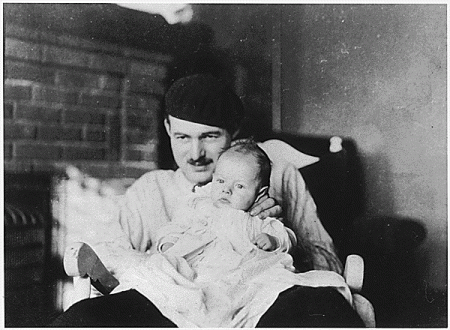
Ernest with Bumby.
It was never clear whether that trust fund of Hadley's was worth $3000 (or, in some versions, $5000) or that was what it yielded. If the latter, the income would have only been far less, which would explain why they had to move out of their hotel and into the apartment on Cardinale-Lemoine. Pauline Pfeiffer, interestingly, had a trust fund of $60,000, as did her sister - courtesy of wealthy uncle Gus.
I tried to order through Amazon but they cancelled the purchase, without explaining why 0. Since Brexit, I've noticed that they do this on anything coming from the UK. If one finds someone who will supply to France, the customs duty, postage etc is exorbitant. Even when I order from Germany or Austria, shipping and other charges double the purchase price.