
WHO'S FOR CIVILIZATION?
THE BATACLAN ATTACK, TEN YEARS ON.

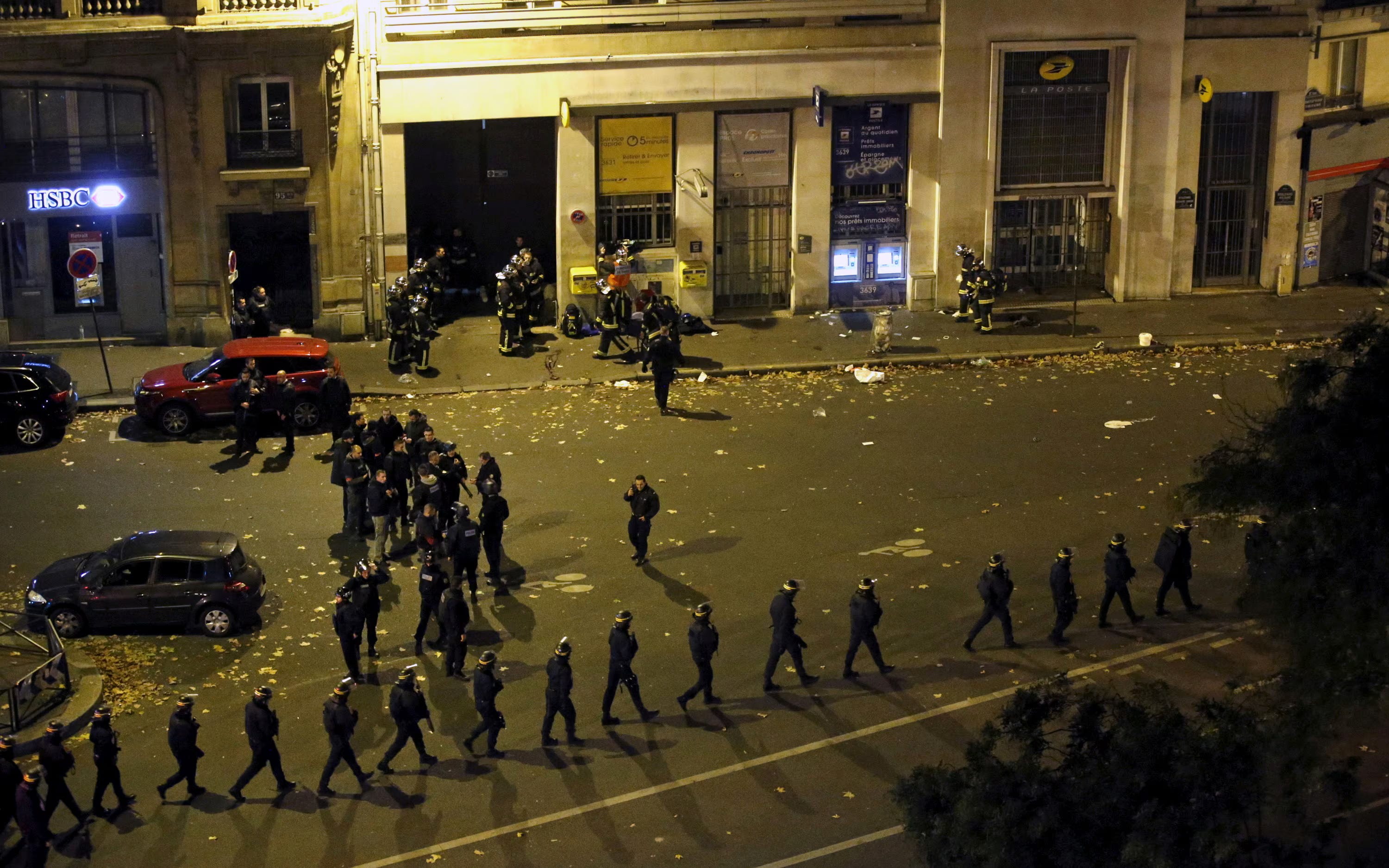
The night of November 13th, 2015.
It’s odd what one remembers….
Exactly ten years ago, I had just arrived home in the late afternoon when a neighbor knocked on the door to tell us that, while the owner was in Japan, burglars had broken into the fourth-floor apartment once occupied by Sylvia Beach, proprietor of the original Shakespeare and Company bookshop, and publisher of Ulysses.
Given what was to happen later, it seems ridiculous that Marie Dominique and I spent the next hour capturing our neighbor’s two cats which, having escaped through the smashed door, were prowling the stairs. As the sun set, we were busy isolating the visiting felines from our own Scotty, who was inclined to be territorial, while at the same time calling our neighbor in Kyoto with the bad news and contacting her housekeeper (who speaks only Rumanian) in order to track down our neighbor’s son, the polar explorer Sebastian Copeland. You would not think a two-meter tall person of Sebastian’s gravitas could be hard to find, but Paris, though charmingly open - too open, in hindsight - can, as we would learn that night, harbor all manner of secrets.
By the time we’d eaten a quick dinner, the worst appeared to be over. The tearful calls to and from Japan were completed, the stolen jewelry lamented, and keys to the new door handed over to Sebastian. Ridiculously, in retrospect, I remember feeling insulted by the brutality of the methods used by the thieves, the lack of finesse. Smash, kick, kill. The crude solutions of lesser minds.
Only then, with all apparently dealt with and under control, did my sister-in-law call.“Is Louise there?” she asked anxiously after our daughter. “Is she safe?” And the television began to ooze the horror that would dominate the night. Only a few hours before, gunmen armed with automatic rifles and hand grenades had burst into the Bataclan concert hall - where Louise often attended concerts - at the height of a performance by the group Eagles of Death Metal, fired and tossed grenades indiscriminately into the crowd, then gone on a rampage through nearby restaurants. 113 people were dead and 413 injured.
Disbelief muffled understanding. This couldn’t be happening here. Journalists assigned to the story appeared to succumb to the same numbness. Halted at a barricade a couple of blocks from the Bataclan, the BBC’s chief correspondent rambled to camera on the improbabilities of the attacks, unaware that police had already burst in to find the hundreds dead - the horror taking place, just as W.H. Auden said, “while someone else is eating or opening a window or just walking dully along.” Or corralling fugitive cats.
Maybe it was the thought of Bruegel and Auden and the old masters that made me dig out the DVDs of Civilization, the 1969 BBC documentary series in which art historian Kenneth Clark assessed the intellectual progress of man. I hadn’t watched it in decades, but on this night it was as consoling to me as the Bible to a believer.
Clark, standing alone on the sunny bank of the Seine, with Notre Dame behind him, began by suggesting that it was “a good moment to look at some of the ways that man has shown himself to be an intelligent, creative, orderly and compassionate animal.” Even more so than half a century ago, this made just as much sense.
I watched for hours as he enumerated a fraction of the works of the creative mind - Chartres, Florence, Dutch painting, English music; Wren, Bach, Picasso: each a further proof that civilization cannot be extinguished, least of all by so crude a tool as physical violence. War, plague, bigotry, fanaticism and genocide might stifle but they can never destroy. Not the human spirit, and certainly not Paris.
What a gorgeous, unsettling braid of memory.
How strange it is—the way catastrophe arrives sideways while we’re busy with the small, domestic chores of being human. Feral cats, broken locks, a neighbor calling from Kyoto… and then suddenly the city we trust reveals its fracture line.
What struck me most here isn’t just the recollection of that night, but the instinct to reach for Civilisation—for Kenneth Clark standing by the Seine making the bold, almost naïve claim that human creativity still outweighs human cruelty. On nights like November 13th, that feels less like thesis and more like a fragile candle held against the wind.
And yet… Paris survived. People sang again. Doors were fixed. Keys were handed over. Someone still had to feed the cats.
Your piece is a reminder that violence shouts, but civilization hums. And the hum—art, memory, presence—always returns.
Merci for this.
Thank you.